

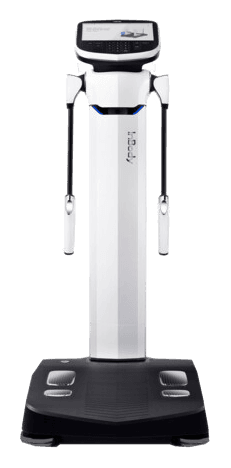
InBody 580
InBody 580: BIA body-composition testing
For following fat and muscle with more detail about individual body regions. At a gym, nutrition practice or clinic, regional water ratios and phase angles add context to your consultation.
A listing is neither manufacturer endorsement nor an accuracy rating.
A practical guide to the test
Learn what happens during the test, how to prepare and what to ask when booking. Always confirm that the provider offers the specific service.
What InBody 580 measures
The 580 is useful when a usual muscle and fat overview is not enough to understand a change. Alongside whole-body results, it reports extracellular water ratio and phase angle for the arms, legs and trunk. This helps frame more specific questions during a consultation; the analyser does not establish the cause of an unusual difference.
Its fixed standing design, large touchscreen and short test suit locations offering regular follow-up. Before your appointment, check which detailed fields the location actually prints or makes available.
Specifications: InBody 580
- Recording time
- ≈ 30 s
- Body weight range
- 5–300 kg
- Height range
- 95–220 cm
- Device weight
- 24.4 kg
- Measurement frequencies
- 5, 50, 250, 500 kHz
- Contact electrodes
- 8
- Measurement position
- Standing
- Operating temperature
- 10–40 °C
Additional documented technical specifications
- Dimensions (width × depth × height)
- 501.9 × 892.4 × 1,124.4 mmEvidence
- Age in the cited catalogue
- From 3 yearsEvidence
- Impedance measurements
- 20Evidence
- Device internal database capacity
- 100,000 recordsEvidence
- Display
- 10.1″ touchscreen TFT LCD, 1280 × 800Evidence
- Documented interfaces
- 2× RS-232C, 2× USB host, Ethernet, Bluetooth and Wi-FiEvidence
- Display diagonal
- 10.1″Model sources
- Hand electrodes
- Three-way grip for consistent hand positioningModel sources
- Result sheets
- Body composition, child and thermal reportsModel sources
- Identification
- Client ID; QR recognition depends on equipment and settingsModel sources
- Connected tests
- Grip and blood pressure from separate instrumentsModel sources
Ages and ranges are documentation entries, not confirmation of suitability for an individual visitor. Dimensions use width, depth, height; pictured accessories may be optional.
Four frequencies, separate body regions
Electrical measurements are taken separately in five body regions. Four frequencies produce twenty impedance values. Body composition is derived from these and other inputs. Reported phase angles are at 50 kHz; they are not five additional frequencies.
Benefits
- Regional water helps put changes in regional lean mass into context.
- Phase angles and fluid ratios are available for the same regions, supporting combined professional interpretation.
- ID-based history and a child report support repeat visits and separate growth assessment.
What the device does not tell you
- A more detailed report needs more interpretation. One unusual regional value without context does not establish a medical problem.
- Testing requires standing and hand and bare-foot contact. Supine testing needs a different device design.
- BMR, visceral fat and minerals are derived values. They do not replace indirect calorimetry, imaging or bone-density testing.
What it adds to the 380, and where the 770S differs
The portable 380 provides whole-body fluid ratio and phase angle. The 580 extends these to five regions and also reports VFA. The 770S adds a measured 1 MHz frequency and a dedicated water report with further specialist displays. Frequency count alone is not proof of greater accuracy for every person; the purpose of follow-up and interpretation of available results matter.
Preparation and comparability
Follow the specific device manual and provider instructions. For repeat BIA, keep time of day and food, activity and fluid conditions similar. Ask the provider about suitability and safety, especially during pregnancy or with implanted electronic devices.
Choose a test →Use and history
Documented use settings
These describe the model context, not available providers or confirmed partnerships.
What to check before choosing
Compared with the 380, you get more detailed regional water and phase-angle information. It is most useful when the location includes those outputs in your report and explains their relevance to your goal.
Exact-model history
The Korean manufacturer records its launch alongside the 380 in October 2023. The European announcement dates from April 2024; these sources do not establish a Czech launch date.
Sources · InBody 580
- InBody — katalog 580 / 580 catalogue (2024)
- InBody — česká příručka 580 / Czech 580 manual
- InBody — globální 580 / global 580
- InBody 580 — česká produktová stránka / Czech product page
- InBody — příprava / test preparation
- InBody Germany — InBody präsentiert InBody 380 & InBody 580
- InBody — Annual Report 2025 / výroční zpráva 2025