

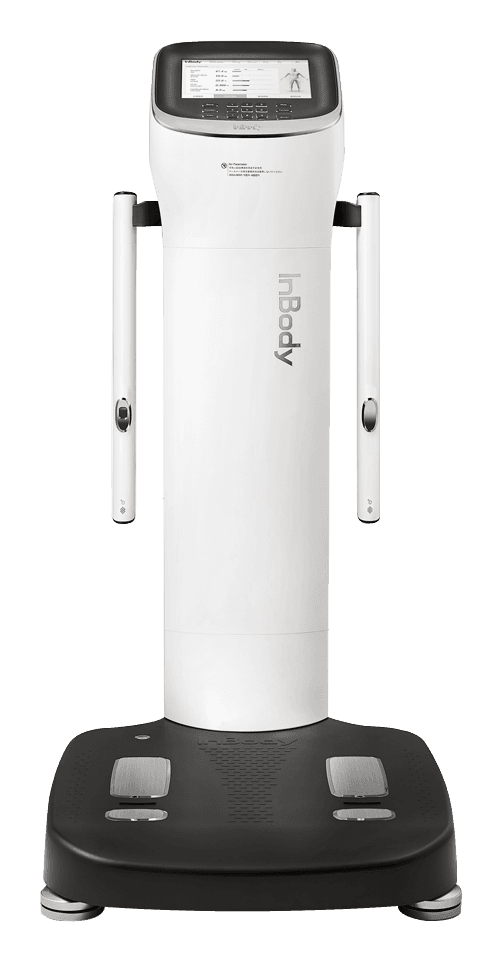
InBody 970/970S
InBody 970/970S is a professional series for segmental body-composition analysis, including body water and phase angle. The variants differ in frequencies and testing time; location details identify the exact model.
Two generations of the 970 series for detailed body-composition analysis. Location search includes both variants; each location’s detail identifies its exact model. Their technical differences are listed separately.
When this test is useful
The InBody 970S shows body water in more detail alongside muscle and fat. If you want to understand a weight change, this can add information to the usual overview. One test can produce several report types: a standard composition report, a water report for fluid distribution and a research report for professional assessment. Your consultation can focus on what matters to you. The test itself takes about 30 seconds and uses six frequencies. The original 970 has eight frequencies and different specifications. The count alone does not tell you which model estimates every value more accurately. When choosing a test, it is more useful to know which results you will receive, how they will be explained and whether you can compare them at future visits under similar conditions.
What the results tell you
Alongside the overall result, you can see the arms, legs and trunk separately. Lean mass in these regions includes water, so it is not a measure of pure muscle in kilograms. If your right and left sides differ, check posture and electrode contact at the next test. A recurring difference is easier to assess than one result.
The water report separates intracellular water (ICW) and extracellular water (ECW). ECW/TBW shows how much of the total water is extracellular, with values for individual regions too. These results add information about changes in weight, fat and muscle. Discuss an unusual value with a professional; it is not a diagnosis by itself.
Whole-body phase angle is reported at 50 kHz. Individual regions have values at 5, 50 and 250 kHz. When following your progress, compare the same region and frequency each time. An arm value at 5 kHz does not describe the same thing as a whole-body result at 50 kHz.
Visceral fat area (VFA) in cm² estimates fat in the abdominal region. Basal metabolic rate helps estimate energy needs, while mineral content adds to the composition overview. All these values are derived from the test. They do not replace fat imaging by CT, direct energy expenditure measurement or a bone density test.
Specialist reports may add BIVA, reference comparisons and charts of changes between tests. A professional can explain their meaning during your consultation. If a combined report includes blood pressure or grip strength, these are results from other tests. A connected monitor measures blood pressure and InGrip measures handgrip; the 970S electrodes do not measure them.
How the device measures
The 970S measures electrical impedance in five body regions at six frequencies from 5 kHz to 3 MHz. This describes how tissue responds to a small electrical current. Detailed results may also include Z0 and Z∞: modelled estimates of impedance at zero and infinite frequency. These are not two extra measured frequencies or direct measurements of individual cells.
Test procedure and preparation
For useful comparisons, arrange tests at a similar time of day, with a similar interval after meals and your usual fluid intake. Avoid testing straight after a workout. Use the restroom first, stand quietly for a while and remove heavy accessories. Bare feet and hands need proper contact with the electrodes. BIA testing is not performed if you have a pacemaker or another active implant. Discuss pregnancy and other relevant medical circumstances with the testing location before your visit.
Limitations and influences
Muscle and fat quantities remain BIA estimates. Hydration and preparation affect this model’s results too. You need to stand steadily and hold the electrodes during the test. The device is not designed for testing while lying down.
Choosing a device and service
Compared with the original 970, the 970S takes less time and uses a different frequency set. Compared with the 270S, it mainly adds detailed water distribution and phase angles for individual regions. The 270S already provides whole-body phase angle. When choosing, ask what the extra values can tell you and whether the location includes them in both the report and consultation.
Specifications: InBody 970/970S
| Parameter | InBody 970S | InBody 970 |
|---|---|---|
| Recording time | ≈ 30 s | ≈ 70 s |
| Body weight range | 2–300 kg | 5–300 kg |
| Height range | 95–220 cm | 95–220 cm |
| Device weight | 41.1 kg | 46 kg |
| Measurement frequencies | 5, 50, 250, 500 kHz; 1, 3 MHz | 1, 5, 50, 250, 500 kHz; 1, 2, 3 MHz |
| Contact electrodes | 8 | 8 |
| Measurement position | Standing | Standing |
| Method and electrodes | DSM-BIA / SMF-BIA; 8 tactile electrodes | DSM-BIA / SMF-BIA; 8 tactile electrodes |
| Measured segments | Right and left arm, trunk, right and left leg | Right and left arm, trunk, right and left leg |
Additional specifications · InBody 970S
- Dimensions (width × depth × height)
- 614.1 × 963.8 × 1,239.3 mm
- Age in the cited catalogue
- From 3 years
- Impedance measurements
- 30
- Device internal database capacity
- 100,000 records
- Display
- 10.1″ colour TFT LCD; 1,280 × 800
- Display diagonal
- 10.1″
- Documented interfaces
- Wi-Fi, Bluetooth
- Segmental phase angle
- 15 values: 5, 50 and 250 kHz × 5 segments
- Identification at testing
- Fingerprint / InBodyBAND recognition
Additional specifications · InBody 970
- Dimensions (width × depth × height)
- 614.1 × 963.8 × 1,239.9 mm
- Age in the cited catalogue
- 3–99 years
- Impedance measurements
- 40
- Device internal database capacity
- 100,000 records
- Display
- 10.1″ colour TFT LCD; 1,280 × 800
- Display diagonal
- 10.1″
- Documented interfaces
- 4× RS-232C, 2× USB host, USB device, Ethernet, Wi-Fi, Bluetooth
Compare models
InBody 970S
InBody 970
Where to get tested
Locations with a documented device. Each location detail describes its service and conditions.
Frequently asked questions
How many frequencies does InBody 970S use?
Six: 5, 50, 250 and 500 kHz, 1 and 3 MHz. Z0 and Z∞ are modelled limits, not extra frequencies. The original 970 uses eight.
Can 970S test someone lying down?
No. It requires stable standing and hand and foot contact. Devices such as S10 or BWA provide a different configuration for lying measurements.
Sources and documentation
Show sources
- InBody — InBody 970S
- InBody Europe — EU manuál 970S / EU 970S manual
- InBody USA — srovnání modelů / model comparison
- InBody — příprava / test preparation
- InBody — Annual Report 2025 / výroční zpráva 2025
- InBody — Annual Report 2023 / výroční zpráva 2023
- ESPEN — Bioelectrical impedance analysis, part I: principles and methods
- ESPEN — Bioelectrical impedance analysis, part II: utilization in clinical practice
- InBody Oceania — InBody 970
- InBody — katalog 970 / 970 catalogue
- InBody Europe — Over InBody