

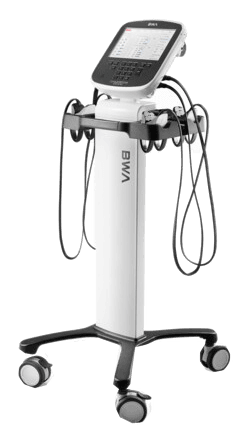
InBody BWA 2.0
The BWA 2.0 focuses on detailed body-water and composition results. Wrist and ankle clamps also allow bedside testing. Its results are especially useful where muscle changes need to be read alongside water changes.
Documented locations are available in Slovakia.
When this test is useful
When body water is the main focus, weight alone is insufficient. The BWA 2.0 separates water inside and outside cells and shows its distribution across the arms, legs and trunk. It adds muscle and fat estimates and phase angle. In clinical care it helps follow change; a professional assesses causes and meaning alongside other information. The original BWA 2.0 can also appear under the shorter name BWA. This page describes the original eight-frequency BWA 2.0. The newer BWA 2.0S has a separate profile because its frequency set, testing time and other parameters differ.
What the results tell you
TBW means total body water, consisting of ICW and ECW. Their changes add context to weight and lean mass. Substantial water changes can also move the muscle estimate without muscle tissue changing at the same rate. Clinical assessment therefore reads these values together.
The ECW/TBW ratio describes the extracellular share of total water. Arm, leg and trunk values add detail and let you follow where a result changes. A deviation alone does not establish its cause or prescribe treatment. Keep posture and procedure consistent for the next check.
The whole-body phase angle is reported at 50 kHz and segmental values at 5, 50 and 250 kHz. Compare matching frequencies and regions. The whole-body value is not simply interchangeable with an average of five regions. Phase angle contributes to professional assessment; it does not explain every health change by itself.
The BWA complements water analysis with muscle, fat and lean-mass estimates, including regional values. Lean mass includes water and other tissues. Water results therefore matter when following muscle; strength requires another test, such as handgrip.
Reports may include both visceral fat area in cm² and visceral fat level. These are different scales without a direct conversion. Like basal metabolic rate or mineral content, they are derived from the test. They do not replace CT, direct energy expenditure measurement or a bone density examination.
Specialist reports add BIVA, a graph of the body’s electrical properties, and compare some values with age-related reference data. T-scores and Z-scores here describe position within the relevant reference group. They are not bone density test results and cannot be read correctly without identifying the assessed parameter.
How the device measures
Electrodes are placed on the wrists and ankles. Their clamp design helps reproduce contact and placement. The BWA 2.0 records impedance in five body regions at eight frequencies up to 3 MHz. Electrical values are used to estimate water and composition. Weight is obtained separately; the device is not a weighing platform.
Test procedure and preparation
Arrange preparation with the location according to your circumstances. For later tests, keep posture, electrode setup, mode and timing relative to meals, activity or treatment similar. Rest in the selected posture before testing as instructed. Weight and height need to be obtained correctly. Do not independently alter treatment or fluid intake for the test. BIA is not performed with a pacemaker or another active implant.
Limitations and influences
Changing posture, electrode placement or mode can affect comparisons. Similar conditions matter for this device too. Weight and height are entered separately. Detailed electrical measurement does not replace correct input values. Detailed results and clinical water changes need professional interpretation; numbers alone do not determine treatment or fluid intake. Blood pressure or grip strength on a combined report comes from additional connected devices, rather than BWA electrodes.
Choosing a device and service
The original BWA 2.0 uses eight frequencies, whereas the newer 2.0S uses six and has a shorter test according to its own catalogue. Both provide advanced water and phase-angle detail, but their specifications are not interchangeable. Compared with the S10, the BWA uses a different clamp-electrode design and a broader range of specialist reports. Start a new comparison series when changing device or procedure.
Specifications: InBody BWA 2.0
- Recording time
- ≈ 90 s (Medical); ≈ 3 min (Research)
- Body weight range
- 10–300 kg
- Height range
- 95–220 cm
- Device weight
- 3.3 kg
- Measurement frequencies
- 1, 5, 50, 250, 500 kHz; 1, 2, 3 MHz
- Contact electrodes
- 16
- Measurement position
- Supine, seated or standing
- Operating temperature
- 10–40 °C
Additional specifications · InBody BWA 2.0
- Dimensions (width × depth × height)
- 322 × 282 × 81.5 mm
- Age in the cited catalogue
- 3–99 years
- Impedance measurements
- 40
- Device internal database capacity
- 100,000 records
- Display
- Colour touchscreen TFT LCD, 1280 × 800 pixels
- Documented interfaces
- RS-232C, USB Host, USB Slave, Ethernet, Bluetooth and Wi-Fi
- Display diagonal
- 10.1″
- Electrode contact
- Wrist and ankle clamps; adhesive electrodes available as accessories
- Weight for the result
- Obtained separately, without a built-in weighing platform
- Report types
- Water, composition, evaluation, research, comparison, child and thermal
- Portable use
- The analyser can be used with a trolley or transport accessories
Compare models
Where to get tested
We have not documented testing on this device in this country yet. Other facilities may use it.
Frequently asked questions
Is BWA 2.0 a scale?
No. Weight and height are obtained separately and entered. Input accuracy affects derived results.
Is BWA 2.0 the same as BWA 2.0S?
No. The original uses eight frequencies and the newer model six. Time and other specifications differ.
Sources and documentation
Show sources
- InBody — BWA 2.0 katalog / catalogue (2021)
- InBody CZ — BWA
- InBody Australia — BWA 2.0
- InBody USA — BWA 2.0 release, 1 April 2022
- InBody — Annual Report 2022, company history
- ESPEN — Bioelectrical impedance analysis, part I: principles and methods
- ESPEN — Bioelectrical impedance analysis, part II: utilization in clinical practice