

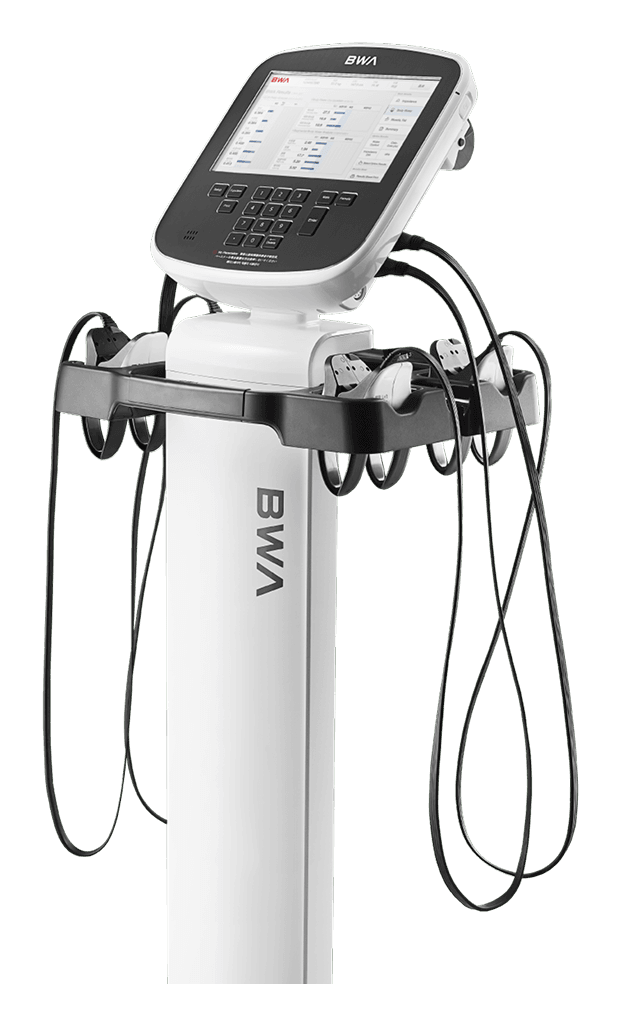
InBody BWA 2.0S
The newer BWA 2.0S combines detailed water results with composition and offers a shorter test than the original BWA. Testing can also take place while lying or seated. It is mainly intended for care where a professional follows water distribution and muscle quantity over time.
When this test is useful
The BWA 2.0S is intended for situations requiring closer understanding of water and composition, including change during clinical care. Testing can take place while lying or seated. Regional values complement the overall overview and help a professional assess change alongside other examinations. The S matters: this model has a different frequency set and testing time from the original BWA 2.0. It is a separate model currently on sale. A particular report may show only some capabilities, depending on settings and report type.
What the results tell you
TBW means total water, ICW the part inside cells and ECW the part outside them. Water change can affect weight and the muscle estimate. Read these values together when following progress. In clinical care, posture, timing relative to treatment and other examinations also matter.
Overall and segmental ECW/TBW ratios show the extracellular share of water. Arm, leg and trunk values help identify where a result changes. A deviation from its reference range does not by itself confirm oedema or its cause. Do not independently change fluid intake or treatment based on a single number.
Whole-body phase angle is at 50 kHz, with regional values at 5, 50 and 250 kHz. Compare matching region, frequency, mode and posture. A higher number is not a universal target for everyone; a professional considers age, condition and the course of change. Phase angle alone does not determine overall health.
Skeletal muscle and lean-mass estimates complement water results. SMI relates limb lean mass to height. It contributes to professional assessment of muscle quantity but does not diagnose sarcopenia on its own. Strength and function require further tests; handgrip on a combined report comes from a separate dynamometer.
Alongside total and regional fat, a report may include visceral fat area in cm² and visceral fat level. Both are estimates and the scales are not interchangeable. Check the parameter name and unit before comparing devices. The BWA2S is not CT and does not directly image fat around organs.
Z0 and Z∞ describe modelled limiting electrical impedance values. They do not mean the device measures current at zero or infinite frequency. BIVA and the Cole-Cole plot use electrical values for specialist assessment. Reference graphs or scores compare a particular parameter; they are not standalone diagnoses.
How the device measures
Clamps attach to the wrists and ankles. The device records impedance in five body regions at six frequencies and adds phase angles. Weight and height are entered separately. Medical and Research modes also differ in contact placement, so consistent procedure matters for repeat testing. The device estimates composition rather than creating an image of muscle or fat. The six measured frequencies cited here follow Czech documentation; regional frequency lists may differ, so use the specification for the actual version.
Test procedure and preparation
The manual recommends spending 10–15 minutes in the testing posture before the test. Keep posture, mode, electrode placement and timing relative to meals, activity or treatment similar for the next check. Enter correctly obtained weight and height. The location determines preparation during dialysis or other medical circumstances; do not independently alter treatment or fluid intake for testing. BIA is not performed with a pacemaker or another active implant.
Limitations and influences
Modes and postures cannot be freely alternated while assuming identical results. A comparable procedure is part of useful tracking. BIA still provides estimates. Entered weight and height, electrode contact and hydration affect the result. Recording amputation, paralysis or dialysis does not make every value usable without professional assessment. The procedure must suit the particular situation. Blood pressure and handgrip on an expanded report are separate measurements. The BWA2S does not obtain them through bioimpedance.
Choosing a device and service
The BWA 2.0S measures at six frequencies and has shorter 30/60 s modes according to its manual. The original BWA 2.0 uses eight, with 90/180 s listed in its 2021 catalogue. Z0/Z∞ in the newer model are calculated values, rather than extra frequencies that erase this difference. Treat your first 2.0S result as a new baseline after switching, even when both reports use similar parameter names.
Specifications: InBody BWA 2.0S
- Recording time
- ≈ 30 s (Medical); ≈ 60 s (Research)
- Body weight range
- 2–250 kg
- Height range
- 95–220 cm
- Device weight
- 2.8 kg
- Measurement frequencies
- 5, 50, 250, 500 kHz; 1, 3 MHz
- Contact electrodes
- 16
- Measurement position
- Supine, seated or standing
- Operating temperature
- 10–40 °C
Additional specifications · InBody BWA 2.0S
- Dimensions (width × depth × height)
- 322 × 282 × 81.5 mm
- Age in the cited catalogue
- From 3 years
- Impedance measurements
- 30
- Device internal database capacity
- 100,000 records
- Display
- Colour touchscreen TFT LCD, 1280 × 800 pixels
- Documented interfaces
- RS-232C, USB Host, USB Slave, Ethernet, Bluetooth and Wi-Fi
- Display diagonal
- 10.1″
- Contacts and modes
- Clamp electrodes; Medical (proximal) and Research (distal) placement
- Weight for the test
- Entered separately; no built-in scale
- Z0 and Z∞
- Modelled limiting impedances, rather than additional measured frequencies
Compare models
Where to get tested
We have not documented testing on this device in this country yet. Other facilities may use it.
Frequently asked questions
Is Z0 or Z∞ an extra frequency?
No. These are modelled limiting impedances. BWA 2.0S measures at six frequencies.
Can sitting and lying results be compared directly?
Not without qualification. Posture changes the test conditions; keep posture, mode and electrodes consistent for tracking.
Sources and documentation
Show sources
- InBody — BWA2.0S katalog / catalogue
- InBody — BWA2.0S User’s Manual (2025)
- InBody CZ — BWA2S
- InBody USA — BWA 2.0S
- InBody UK — BWA 2.0S
- InBody — BWA 2.0 catalogue (2021)
- InBody — Annual Report 2025, company history
- FDA / NLM — BWA2.0S, GUDID (2024)
- ESPEN — Bioelectrical impedance analysis, part I: principles and methods
- ESPEN — Bioelectrical impedance analysis, part II: utilization in clinical practice
- EWGSOP2 — Sarcopenia: revised European consensus on definition and diagnosis