

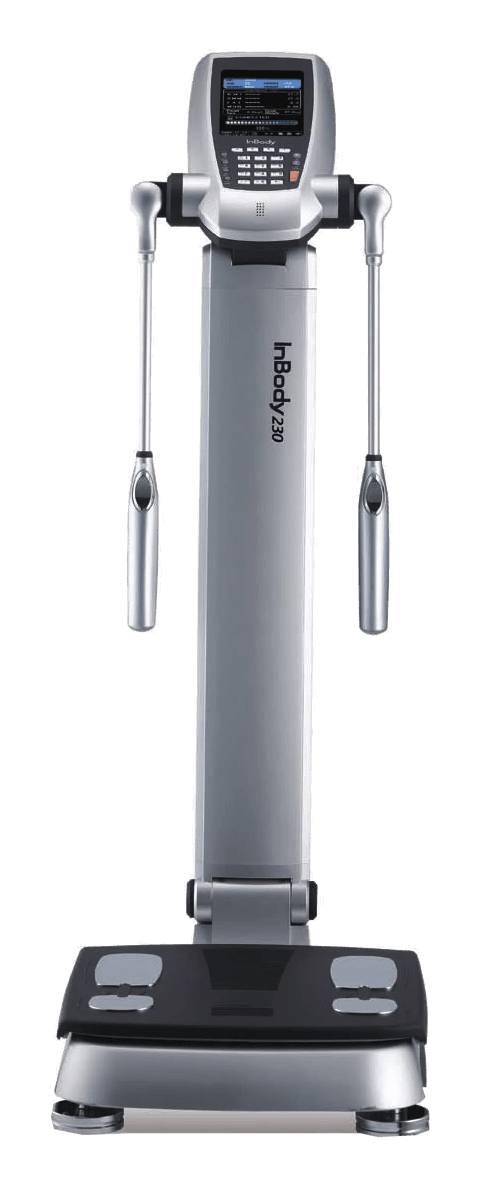
InBody 230
InBody230 is an older model you may encounter at nutrition practices. It helps put weight changes in the context of fat and muscle. Testing is most useful with results explained and compared with previous visits.
When this test is useful
InBody 230 was used by many early Czech nutrition and fitness services. Its results are useful for a simple question: what is changing when my weight changes? Separating fat from fat-free mass helps you explore that question. This profile describes the original 230, not the later 270. It is an older model still used at some testing locations. Before booking, check which report you will receive and whether the appointment includes an explanation.
What the results tell you
Read fat mass in kilograms and percent body fat together. Percent body fat is a share of total weight: it can change when water or other fat-free mass changes. When following weight loss, look beyond a coloured “normal” band to kilograms and a series of results.
Total skeletal muscle mass and segmental lean analysis answer different questions. One describes the muscle component of the whole body; the other shows fat-free mass distribution across limbs and trunk. A segment does not contain muscle alone: water and other non-fat tissue are included.
When two nearby tests differ markedly, check TBW and recall the testing conditions. Different fluid intake, demanding exercise or time of day can affect the estimate. The standard 230 sheet does not provide a detailed ECW/TBW view.
The brochure lists an estimated waist-to-hip ratio, WHR. This ratio is not the amount of fat around organs and has no cm² unit. If waist size matters to you, add regular tape measurements for another practical and understandable data point.
The children’s report adds growth charts. A child’s result should therefore not be read using adult fat or BMI cut-offs. For adults and children, BMR is a calculated estimate of resting energy; a diet plan must consider activity and other needs.
How the device measures
The device measures electrical impedance in five body segments. It needs correctly entered height and firm contact between feet, hands and electrodes. The resulting fat or muscle values are estimates based on those measurements. The brochure’s phrase about no empirical estimation does not mean that every tissue was weighed separately.
Test procedure and preparation
Ask your provider for preparation instructions and follow them consistently for repeat visits. Avoid exercise immediately before testing, remove heavy accessories and use the toilet beforehand. Feet and hands must contact the electrodes properly. Declare a pacemaker or another electronic medical device beforehand; the original manufacturer instructions prohibit use in this situation.
Limitations and influences
The standard brochure sheet does not list phase angle, ECW/TBW or visceral fat level or area. Do not assume that another model’s outputs apply to 230. Czech documentation states that technical support has ended for 230 units manufactured in 2015 or earlier. Older software may also be incompatible with current computers or exports. Estimated mineral content or a children’s growth graph is not a bone density examination or a standalone assessment of a child’s development.
Choosing a device and service
The original 270 continues the portable format and basic body composition analysis. 270S is a separate newer model with whole-body phase angle. For more detailed fluid distribution, also consider 770 or 970S. Frequency count alone does not tell you how accurate your individual test will be; choose the outputs and service quality you need.
Specifications: InBody 230
- Recording time
- 30 s
- Body weight range
- 10–250 kg
- Height range
- 95–220 cm
- Device weight
- 14.5 kg
- Measurement frequencies
- 20, 100 kHz
- Contact electrodes
- 8
- Measurement position
- Standing
- Operating temperature
- 10–40 °C
Additional specifications · InBody 230
- Dimensions (width × depth × height)
- 356 × 843 × 984 mm
- Age in the cited catalogue
- 3–99 years
- Impedance measurements
- 10
- Device internal database capacity
- 1,000 records
- Display
- 240 × 320 colour LCD and buttons
- Documented interfaces
- RS-232C, USB computer connection and USB printer connection; transfer depends on compatible legacy software.
- Construction
- Foldable stand; transport in a suitable carrying case
- Result sheets
- Adult and children’s sheets; optional thermal printing
- Height entry
- Entered manually; the scale does not measure height itself
Compare models
Where to get tested
Locations with a documented device. Each location detail describes its service and conditions.
Frequently asked questions
Is 230 WHR a visceral-fat result?
No. It estimates waist-to-hip ratio, rather than VFA in cm² or visceral fat level.
Does 230 provide ECW/TBW?
The standard brochure sheet does not list it. Total water TBW is a different result.
Sources and documentation
Show sources
- InBody230 catalogue — BC-ENG-40-I-140917
- InBody230 — pokyny výrobce
- AFIT — analýza na InBody 230
- Ne hladu — ceník
- InBody CZ — ukončení prodeje 230
- InBody CZ — podpora starších přístrojů
- ESPEN — Bioelectrical impedance analysis, part I: principles and methods
- ESPEN — Bioelectrical impedance analysis, part II: utilization in clinical practice