

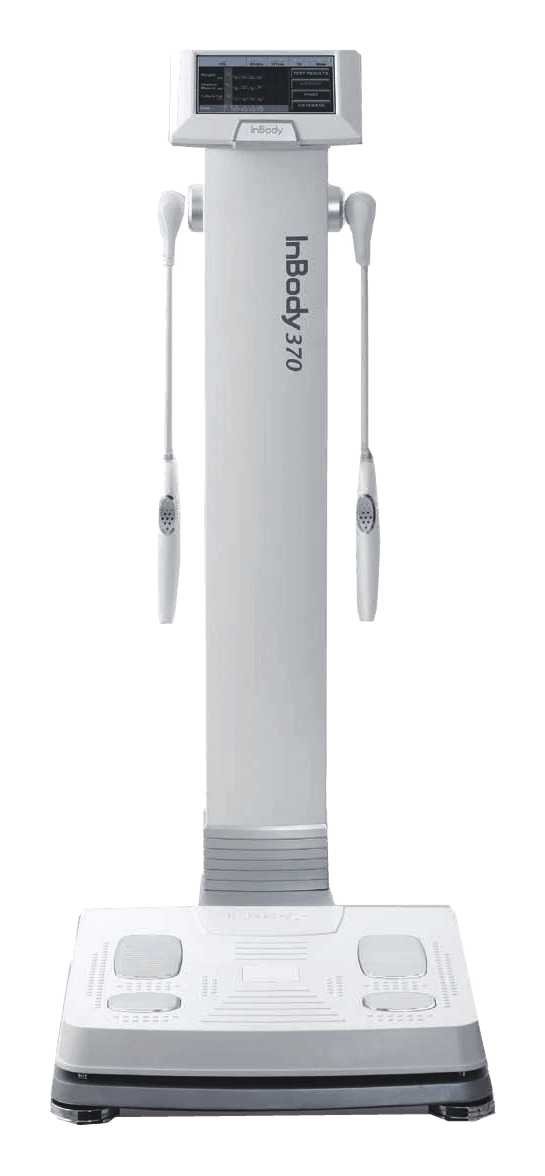
InBody 370
The older InBody370 provides a clear comparison of fat, muscle and their distribution across repeat visits. Results also cover individual limbs. An explanation helps you decide which findings matter for your diet or activity.
When this test is useful
Use the full model name when identifying InBody 370. The S denotes a different model: you cannot automatically add 370S specifications or outputs to an older 370 report. The original 370 also appears in Czech services with consultation, including the University of West Bohemia’s Faculty of Health Care Studies. Its report offers a starting point for three questions: how much weight is fat, what is happening to skeletal muscle, and how is lean mass distributed? Bring your old sheet to a follow-up appointment. Reviewing several visits together is often more useful than judging one number.
What the results tell you
Skeletal muscle mass, fat mass and percent body fat give weight more context. If weight stays similar while fat falls across several visits and the muscle estimate is maintained, you may see progress that a bathroom scale misses. A single test does not establish that trend.
Separate arms, legs and trunk help reveal differences between sides. The result estimates lean mass rather than isolated muscle volume or strength. For a return after injury, combine these values with a movement assessment; the table alone does not show how you use the limb.
TBW complements the fat-free mass estimate. Protein and mineral values come from the body composition model: they are not blood tests or bone density measurements. For swelling or bone health concerns, choose further assessments with a health professional.
BMI uses height and weight; percent body fat adds an estimate of composition. WHR is an estimated waist-to-hip ratio. These measures have different meanings and need not change together. The original 370 standard brochure does not list visceral area or level.
BMR is a calculated estimate of resting energy. The summary score and automatic fat or muscle adjustment suggestions can start a conversation, but are not mandatory targets. A realistic plan needs to fit your activity, health and what you can maintain over time.
How the device measures
370 uses segmental bioimpedance. A weak electrical signal passes between hand and foot electrodes; measured impedance is used to estimate body water and other components. Multiple frequencies do not mean that every reported value was measured independently. Interpretation also needs the circumstances of the visit.
Test procedure and preparation
Agree on preparation beforehand and keep it similar on repeat visits. Avoid testing immediately after intense exercise or a sauna. Remove shoes, socks and heavy accessories, then stand quietly for a while. Hold your arms away from the body as instructed. Declare a pacemaker or another electronic medical device beforehand; the manufacturer prohibits use in that situation.
Limitations and influences
The standard brochure report does not list ECW/TBW or whole-body or segmental phase angle. Frequency count alone does not establish their availability. 370 requires stable standing with hand electrodes. Someone unable to maintain that position safely needs another approach. Legacy exports and a provider’s extended software may use different reports. Check labels and units before comparing two values.
Choosing a device and service
370S retains basic segmental analysis, with a faster test, different design and visceral fat level in its standard manual. For fluid ratios or phase angle, also compare 770, 770S and 970S. A higher model number alone does not guarantee a better choice; the information you actually need matters.
Specifications: InBody 370
- Recording time
- 45 s
- Body weight range
- 10–250 kg
- Height range
- 95–220 cm
- Device weight
- 20 kg
- Measurement frequencies
- 5, 50, 250 kHz
- Contact electrodes
- 8
- Measurement position
- Standing
- Operating temperature
- 10–40 °C
Additional specifications · InBody 370
- Dimensions (width × depth × height)
- 460 × 677 × 1,020 mm
- Age in the cited catalogue
- 3–99 years
- Impedance measurements
- 15
- Device internal database capacity
- 100,000 records
- Display
- 800 × 480 colour touchscreen LCD
- Documented interfaces
- RS-232C, USB computer connection and USB printer or backup connection; Lookin’Body compatibility depends on version.
- Result sheets
- Adult and children’s sheets; optional thermal printing
- History and export
- Records under an ID; USB backup and Lookin’Body compatibility depending on version
- Height
- Entered manually or supplied by a connected stadiometer
Compare models
Where to get tested
Locations with a documented device. Each location detail describes its service and conditions.
J. Pitry 344, Opočno
Vančurova 1548, Kladno
Frequently asked questions
Is 370 the same as 370S?
No. Construction, time and outputs differ. One model’s documentation cannot automatically be applied to the other.
Does 370 provide visceral fat area?
The original 370 standard brochure does not list it. WHR is a separate result.
Sources and documentation
Show sources
- InBody370 catalogue — BC-ENG-81-C-140917
- InBody370 Install Manual — BM-ENG-81-F-181224
- FZS ZČU — InBody 370
- Colliery RECOVERY — služby
- InBody Japan — BIA and InBody history
- ESPEN — Bioelectrical impedance analysis, part I: principles and methods
- ESPEN — Bioelectrical impedance analysis, part II: utilization in clinical practice