

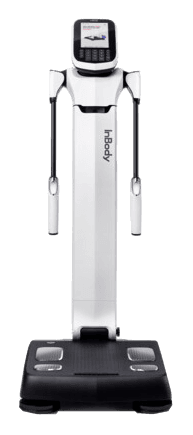
InBody 380
For following fat and muscle changes at a gym, nutrition practice or mobile testing event. Adds a body-water ratio and whole-body phase angle to the usual overview for discussion during a consultation.
When this test is useful
The 380 is useful when you want more context than fat and muscle but the location also needs to transport its analyser. Its column folds down and the handles stay with the device. Unlike the low-profile 120, it has its own touchscreen controls and stores tests by ID. Portability is a practical operating feature; the exact model and report settings determine the outputs. The key difference from the 580 is the level of detail: the 380 reports phase angle and fluid ratio for the whole body. Segmental lean and fat analysis is still available, but this does not automatically mean regional phase angles.
What the results tell you
Fat in kilograms, body fat percentage and estimated skeletal muscle put weight changes into context. Muscle quantity is not a strength test. If muscle function matters too, the location can add a separate InGrip handgrip test.
The ECW/TBW ratio describes the extracellular share of total body water. A detailed report may also list ICW and ECW in litres. It is not a direct answer to how much you should drink. An unusual result needs context and professional interpretation.
The whole-body phase angle at 50 kHz adds information about the body’s electrical properties. For repeat tests, use the same device and similar preparation. One number does not establish the health of every cell or measure immunity; suitable reference values depend on the person being assessed.
Arms, legs and trunk have their own lean and fat overview. Lean tissue includes water. For a recurring side-to-side difference, check posture, follow the trend and consider a movement assessment when relevant.
The manufacturer’s catalogue lists visceral fat level, BMR, mineral content and body composition indices. Fat level is not VFA in cm². BIA mineral estimates are not a bone-density examination, and calculated BMR does not replace direct energy expenditure measurement.
How the device measures
The 380 measures arm, leg and trunk impedance at three frequencies, producing fifteen impedance values. Derived muscle, fat and water quantities are a different kind of result from these electrical measurements. Whole-body phase angle is reported at 50 kHz.
Test procedure and preparation
Keep your usual fluid intake, a similar interval after meals and a similar appointment time. Avoid testing straight after exercise. Use the restroom, stand quietly and check bare-foot and hand contact. BIA is not performed with an active implant. Discuss pregnancy or other relevant medical circumstances with the location beforehand.
Limitations and influences
The manufacturer’s list does not document regional phase angles or regional ECW/TBW. Compare the 580 or 770S for those outputs. The analyser requires a steady standing posture and correct electrode grip. A client unable to stand needs a different testing arrangement. Body composition remains an estimate affected by preparation and body water. Displayed decimal places do not guarantee matching measurement precision.
Choosing a device and service
The 270S already provides whole-body phase angle. The 380 adds whole-body ECW/TBW and a different frequency set. The 580 extends fluid ratio and phase angle to individual body regions and offers a larger display. More frequencies alone do not identify the best device for your question.
Specifications: InBody 380
- Recording time
- ≈ 30 s
- Body weight range
- 5–300 kg
- Height range
- 95–220 cm
- Device weight
- 16 kg
- Measurement frequencies
- 5, 50, 500 kHz
- Contact electrodes
- 8
- Measurement position
- Standing
- Operating temperature
- 10–40 °C
Additional specifications · InBody 380
- Dimensions (width × depth × height)
- 415.5 × 871.5 × 1,069.9 mm
- Age in the cited catalogue
- From 3 years
- Impedance measurements
- 15
- Device internal database capacity
- 100,000 records
- Display
- 7″ touchscreen TFT LCD, 480 × 800
- Display diagonal
- 7″
- Documented interfaces
- 2× RS-232C, 2× USB host, Ethernet, Bluetooth and Wi-Fi
- Construction
- Folding column and three-way hand electrodes
- Result sheets
- Body composition, child and thermal reports
- Client identification
- ID entry and QR recognition option; depends on equipment
- Operating modes
- Professional and self-service modes
Compare models
Where to get tested
Locations with a documented device. Each location detail describes its service and conditions.
Smetanovo náměstí 979/2, Ostrava
Frequently asked questions
Does 380 provide water ratios for every limb?
The verified list documents whole-body ECW/TBW rather than segmental ratios. Compare 580, 770S or 970S for regional water.
Is 380 portable?
Its column folds for transport. Testing still requires correct installation, stable standing and preparation.
Sources and documentation
Show sources
- InBody — katalog 380 / 380 catalogue (2024)
- InBody — globální 380 / global 380
- InBody 380 — česká produktová stránka / Czech product page
- InBody — česká příručka 380 / Czech 380 manual
- InBody — příprava / test preparation
- InBody Germany — InBody präsentiert InBody 380 & InBody 580
- InBody — Annual Report 2025 / výroční zpráva 2025
- ESPEN — Bioelectrical impedance analysis, part I: principles and methods
- ESPEN — Bioelectrical impedance analysis, part II: utilization in clinical practice