

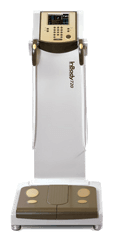
InBody 720
An older detailed analyzer for following body composition and water during nutrition or sports programmes. Research mode adds regional phase angles; your report’s scope depends on the location’s settings.
When this test is useful
An InBody 720 report can still be useful today. Alongside weight, the device estimates fat, lean mass and water distribution. Results for the arms, legs and trunk complement the overall picture. For tracking change, the same device and similar preparation are more useful than a one-off comparison with another model. The 720 belongs to an older generation and testing is still available at some locations. The values on your report also depend on the selected mode and software version.
What the results tell you
Read weight alongside fat, body fat percentage and estimated muscle mass. Lean mass includes water and other tissues, rather than only muscle. If it changes quickly, check water and testing conditions too. Muscle quantity alone does not tell you how strong it is.
Arm, leg and trunk results show lean-mass distribution and help you follow side-to-side differences. Kilograms of lean mass are not kilograms of pure muscle. A recurring difference in consistently performed tests is more useful than a single deviation.
ICW is water inside cells and ECW is water outside them. ECW/TBW expresses the extracellular share of total water. It helps put weight and lean-mass changes into context. An older report may label the ratio Edema, but the number alone does not establish the cause or confirm a diagnosis of oedema.
The verified manual lists phase angles for the arms, legs and trunk at 5, 50 and 250 kHz. These values are not printed in the shorter Medical mode. Compare the same region and frequency each time; a segmental value is not the same as whole-body phase angle from another model. A professional consultation can help explain it.
Some 720 reports include VFA in cm², an estimate of the area of fat around abdominal organs. The device does not image this fat as CT does. If your report has no VFA value, that does not mean zero fat. Check the unit too: area, visceral fat level and waist circumference describe different values.
How the device measures
The platform measures weight, while the electrodes record impedance in five body regions at six frequencies. Research mode adds resistance, reactance and phase angle at three frequencies. Body composition is estimated from these measurements; this is neither direct muscle weighing nor an imaging examination.
Test procedure and preparation
Arrange a similar time of day to your previous test and maintain your usual fluid intake and a similar interval after meals. Avoid testing straight after training, use the restroom first and stand quietly for a while. Bare feet and hands need proper electrode contact. BIA is not performed with a pacemaker or another active implant; discuss pregnancy and other circumstances with the location beforehand.
Limitations and influences
Older and regional reports differ. A desired value may not appear on every printout or in every export. Testing requires steady standing and holding the hand electrodes. The S10 or BWA series supports testing while lying down. Czech documentation states that technical support has ended for 720 units manufactured in 2015 or earlier; current LookinBody120 MDR does not support their outputs. The particular unit and its manufacturing year matter. Hydration and preparation affect BIA estimates. Even a detailed report does not replace further examination when you have health concerns.
Choosing a device and service
Compared with the 520, the 720 adds measured frequencies and, in research mode, electrical values including segmental phase angle. The 770 is a separate newer generation; a matching frequency set does not make the measurement, software or report identical. Establish a new baseline when switching and focus on subsequent results from the same device.
Specifications: InBody 720
- Recording time
- < 60 s (Medical); < 2 min (Research)
- Body weight range
- 10–250 kg
- Height range
- 95–220 cm
- Device weight
- 45 kg
- Measurement frequencies
- 1, 5, 50, 250, 500 kHz; 1 MHz
- Contact electrodes
- 8
- Measurement position
- Standing
- Operating temperature
- 10–40 °C
Additional specifications · InBody 720
- Dimensions (width × depth × height)
- 520 × 870 × 1,200 mm
- Age in the cited catalogue
- 3–99 years
- Impedance measurements
- 30
- Reactance measurements
- 15
- Display
- Colour TFT LCD, 640 × 480 pixels
- Documented interfaces
- RS-232C, USB Host, Ethernet and IEEE 1284 parallel printer port
- Measured regions
- Right and left arm, trunk, right and left leg
- Weight and height
- Built-in weighing platform; height is entered
- Report modes
- Medical for the standard report; Research for additional electrical values
Compare models
Where to get tested
Locations with a documented device. Each location detail describes its service and conditions.
Svatá Kateřina 327, Počátky
Frequently asked questions
Why does my 720 sheet have no phase angle?
Medical does not print it. Research adds resistance, reactance and regional phase angles at three frequencies.
Does the Edema label diagnose swelling?
No. It labels a water ratio on an older report. Interpretation requires clinical context and other information.
Sources and documentation
Show sources
- InBody — InBody 720 User’s Manual
- Biospace — Results Interpretation & Application
- Masarykova univerzita — InBody 720 / laboratory
- InBody CZ — podpora starších přístrojů / older device support
- Biospace — 510(k) Summary K052646
- ESPEN — Bioelectrical impedance analysis, part I: principles and methods
- ESPEN — Bioelectrical impedance analysis, part II: utilization in clinical practice