U letiště 976/32, Olomouc
Price not listed


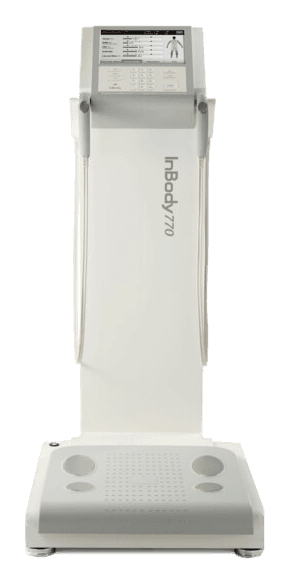
For detailed nutrition or clinical consultations and training follow-up. Alongside fat and muscle, it provides a dedicated water report, water distribution and phase angles. Testing takes place standing up.
With the 770, ask about the report as well as the model name. Alongside the usual muscle and fat overview, a dedicated water report provides whole-body and regional values. For follow-up, this can give more context than weight or body fat percentage alone. The original 770 and newer 770S have separate documentation. This page describes the original 770’s 38 kg configuration documented in the Czech manufacturer manual. Older units may differ in specifications and printable fields.
The report combines weight, skeletal muscle, fat mass and body fat percentage. Segmental lean mass shows distribution between the limbs and trunk. Lean mass is not identical to muscle: it includes water and other tissues. For a short-term change, also look for context in the water values.
The report separates TBW, ICW and ECW and adds ECW/TBW and a regional overview. Consider litres, ratios and history together: the same proportion can accompany different absolute water volumes. This overview alone does not determine fluid requirements or treatment.
Water estimates and ECW/TBW for the arms, legs and trunk help describe where a change occurs. A difference is not automatically proof of oedema or injury. A repeated unusual result needs consideration of posture, electrode contact, preparation and professional assessment of the person’s condition.
Manufacturer manual revision H documents whole-body and regional phase angle at 50 kHz. Check whether your report and software version provide it. For follow-up, keep the device and testing procedure consistent; the angle does not establish a diagnosis or directly assess immunity.
VFA estimates visceral fat area; detailed outputs also include VFL, FFMI and FMI. The manual lists derived circumferences too. These differ from tape measurements or abdominal imaging. When changing methods, do not join values into one trend without checking their meaning.
The 770 measures impedance in five regions at six frequencies. It separately lists fifteen reactance measurements at three frequencies. Reactance is a component of impedance, not an extra set of frequencies. Body composition is derived from electrical data; the revision H report provides whole-body and regional phase angle at 50 kHz.
For repeat visits, keep a similar time and interval after meals, maintain your usual fluid intake and avoid testing immediately after exercise. Use the restroom and stand quietly beforehand. Hands and bare feet must contact the electrodes correctly. BIA is not performed with an active implant; discuss pregnancy and other relevant circumstances with the location before visiting.
The 770 name does not identify one unchanging hardware and software version. Check the documentation for the particular unit. The analyser requires safe standing and correct grip. This test is not designed for a seated or supine posture. BIA does not provide fat-tissue imaging, bone density or direct muscle strength testing. Those questions need other methods.
The original 770 measures six frequencies including 1 kHz. The 770S catalogue lists five measured frequencies from 5 kHz and separately describes Z0 as a value at the zero-frequency limit. The S offers a shorter test and a lower minimum testing weight. The S designation cannot therefore be explained as simply adding a frequency. When changing models, check that output types and testing conditions remain comparable.
Locations with a documented device. Each location detail describes its service and conditions.
U letiště 976/32, Olomouc
Budínova 67/2, Praha
No. They have separate frequency sets, specifications and documentation. Establish a new baseline when switching.
Not necessarily. Version, mode, sheet and software affect the available fields. Confirm your required outputs when booking.