

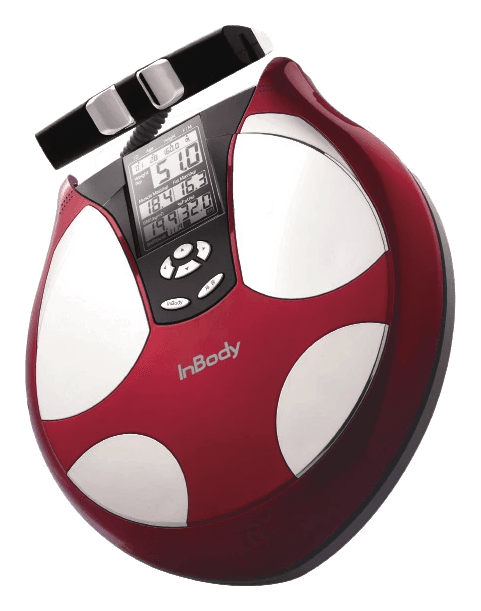
InBody R20
R20 was developed for home body-composition monitoring and also appears in some fitness services. It gives a basic muscle-and-fat overview. For a more detailed consultation, it matters whether the provider also uses the computer report.
When this test is useful
R20 looks like a bathroom scale, but adds hand electrodes. The test uses both hands and feet and works with individual body segments. This older compact model still appears in Czech services. Before booking, ask whether you receive the full computer report or only the basic values. Do not shorten R20 to “20” or assume that it is R20B. Documentation distinguishes cable and Bluetooth variants. For your history, it also matters whether the provider’s original software still works.
What the results tell you
The display provides weight, fat and skeletal muscle mass, percent body fat, BMI and BMR. Start with fat in kilograms alongside the percentage: the percentage is a share of total weight, so water changes can affect it too. One lower display value is not a longer-term outcome.
The brochure distinguishes the basic display from the more detailed Lookin’Body Basic report, which adds lean and fat distribution. Check whether this report is available when booking. Segmental lean values include water and other non-fat tissue rather than muscle alone.
The extended software adds TBW and FFM. These can help explain a rapid difference between visits, particularly when preparation changed. Total water alone does not replace ECW/TBW or an assessment of the cause of swelling.
BMR estimates resting energy requirements. Additional software suggestions can start a consultation, but are not a diet or training plan. An appropriate approach also depends on activity, experience and health context.
The brochure lists an estimated waist-to-hip ratio, WHR, in Lookin’Body Basic. It is not visceral area in cm². Add a consistently taken tape measurement of your waist for everyday monitoring; it helps relate the result to changes in body shape.
How the device measures
You stand on the base and hold the hand electrodes away from the trunk. Bioimpedance measures electrical properties of limbs and trunk to estimate water, fat-free mass and fat. Weight-only mode is different: without correctly holding the electrodes, you do not obtain the same body composition analysis.
Test procedure and preparation
For repeat tests, keep time of day and conditions after food, drink and activity similar. Use the toilet and stand quietly beforehand. Step onto the base barefoot; palms and thumbs must contact the hand electrodes correctly. Declare a pacemaker or another electronic medical device beforehand; the original R20 manual prohibits use in this situation.
Limitations and influences
The original brochure range ends at 150 kg. Check the specific unit when booking near that limit; specifications of larger InBody devices do not apply here. Some useful values depend on legacy computer software. The display, stored history and printed software report can contain different information. The verified standard brochure sheet does not list phase angles, ECW/TBW or a separate visceral fat output. General claims about the brand’s technology do not establish those outputs.
Choosing a device and service
R20 is more compact and relies on original software for its detailed sheet. 120 and 270 have a different design and higher weight ranges. 270S adds whole-body phase angle; compare 770S or 970S for more detailed water analysis. Choose by the complete report rather than the number of values that fit on a display.
Specifications: InBody R20
- Recording time
- 30 s
- Body weight range
- 10–150 kg
- Device weight
- 3 kg
- Measurement frequencies
- 20, 100 kHz
- Contact electrodes
- 8
- Measurement position
- Standing
- Operating temperature
- 10–40 °C
Additional specifications · InBody R20
- Dimensions (width × depth × height)
- 321 × 360 × 58 mm
- Age in the cited catalogue
- 6–99 years
- Impedance measurements
- 10
- Device internal database capacity
- 300 records
- Display
- LCD with basic results and buttons
- Documented interfaces
- Cable USB to the original Lookin’Body Basic. Bluetooth belongs to the R20B variant.
- Power
- AA batteries; the original documentation specifies battery operation
- Modes
- Body composition analysis and weight-only mode
- Detailed report
- Original Lookin’Body Basic on a computer; requires a working connection
- Variants
- Original R20 with USB; R20B is a separate Bluetooth variant
Compare models
Where to get tested
Locations with a documented device. Each location detail describes its service and conditions.
Frequently asked questions
Is R20 identical to R20B?
Not entirely. The manufacturer submission distinguishes R20 and Bluetooth R20B. The general R20 name alone does not establish connectivity.
Will I see segments directly on the display?
The brochure places them in the extended Lookin’Body Basic report. Check whether the location provides it.
Sources and documentation
Show sources
- Biospace — FDA K092786
- InBody R20 brochure — BC-ENG-00-A-090706
- InBody R20 — původní uživatelský manuál
- Lady-Fit Znojmo — InBody R20
- Lady-Fit Znojmo — ceník
- Slim Nest Beauty — procedury
- InBody — tisková zpráva k 29. výročí / 29th anniversary press release
- ESPEN — Bioelectrical impedance analysis, part I: principles and methods
- ESPEN — Bioelectrical impedance analysis, part II: utilization in clinical practice