

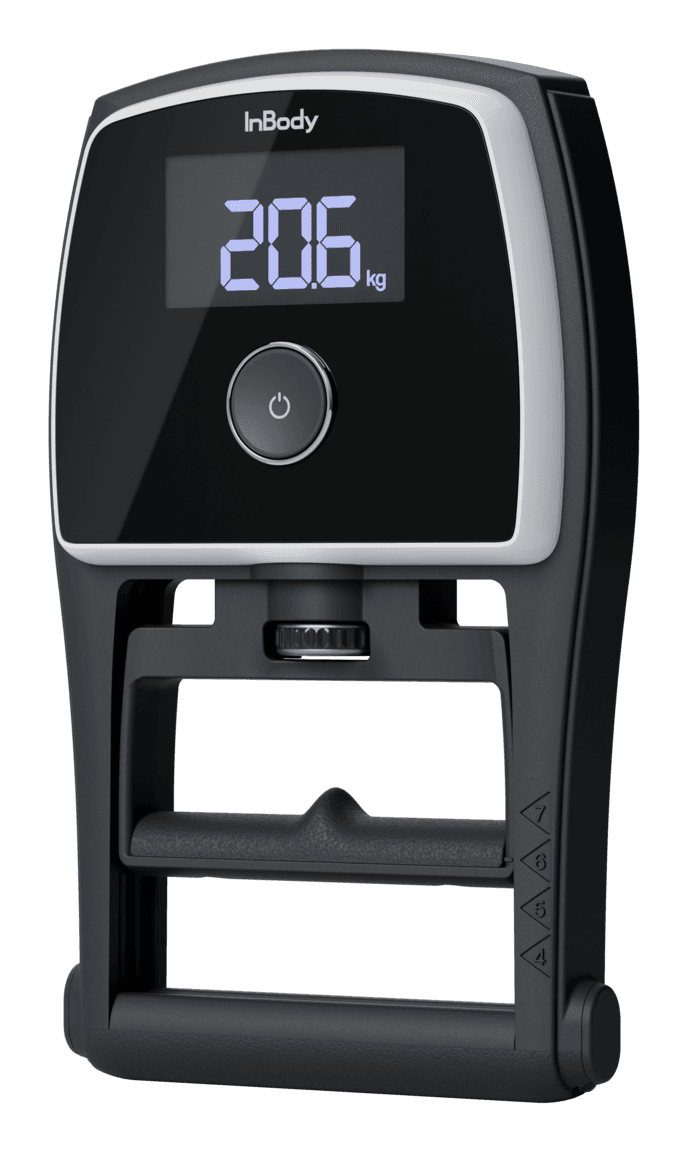
InBody InGrip
The InGrip shows how strongly you can squeeze its handle. This direct hand-strength test complements the muscle-quantity estimate from InBody. It is useful in training, rehabilitation and professional assessment of muscle function.
When this test is useful
You hold the handle, squeeze it and InGrip shows your grip strength in kilograms. Each hand is tested separately. You get a straightforward result to return to at later visits and see how your strength changes. Alongside an InBody result, grip adds useful context: how much muscle you have and what you can do in this strength test. During training or weight loss, those numbers may change differently. Reading them together gives you more context than weight or a single strength value alone.
What the results tell you
HGS is grip strength in kilograms. Look at each hand and the difference between them; the hand you use more may be stronger. At the next visit, compare attempts made in a similar way. A best performance and an average across several attempts can give different results.
The HGS/WT ratio puts your grip strength in relation to body weight. It can help you follow your own progress, but read it alongside strength in kilograms: during weight loss, the ratio can rise even if your grip stays the same.
You can have the same muscle quantity and gradually develop a stronger grip. You can also maintain muscle mass yet perform less strongly in the test. Fatigue and pain play a part too. A repeated decline deserves attention; one weaker attempt does not establish a disease or sarcopenia.
How the device measures
A force sensor inside the handle records how hard you squeeze. The guide helps you hold it in the same way each time. Hand position, fatigue and pain also affect the result, so a similar setup makes repeat tests more useful.
Test procedure and preparation
Ask to be shown a comfortable grip and the right hand position. Rest between attempts and use a similar setup on later visits. Tell the operator if your hand hurts or you have just trained it. After a recent injury or with acute pain, discuss a maximal squeeze with a professional first.
Limitations and influences
Grip does not describe the strength of every muscle group or endurance. Muscle quantity needs a different measurement. Pain, fatigue and how you hold the handle can change the result. Numbers from different dynamometers may not be directly comparable. The display shows tenths of a kilogram, while the manufacturer states a measurement error of ±0.5 kg. A small difference between attempts is not necessarily a change in strength.
Choosing a device and service
InBody 270, 270S, 970 and 970S show estimated muscle and fat quantities. InGrip adds grip strength. A combined results sheet lets you read both side by side. HGS always comes from a separate dynamometer, even when it is printed on an InBody sheet.
Specifications: InBody InGrip
- Device weight
- 0.65 kg
- Grip strength range
- 1–100 kg
- Measured quantity
- Hand grip strength
- Declared error range
- ±0.5 kg
- Display increment
- 0.1 kg
Additional specifications · InBody InGrip
- Dimensions (width × depth × height)
- 140 × 226 × 50 mm
- Display
- 3″ VA LCD
- Documented interfaces
- Bluetooth 5.0
- Display diagonal
- 3″
- Power supply
- 2× AA, 3 V
Where to get tested
Locations with a documented device. Each location detail describes its service and conditions.
Karlov pod Pradědem č. 182, Malá Morávka
Frequently asked questions
Does InGrip measure muscle quantity?
No. It measures force applied to the handle. InBody can add muscle quantity; the two results are assessed separately.
Why can consecutive attempts differ?
Grip, posture, motivation, fatigue and pain affect performance. Rest and a consistent procedure matter; one weaker attempt does not establish disease.